Balancing offense and defense in Builder Base loot strategy
20 min read Turn wins into steady loot by balancing attack power and base strength in Builder Base.
Balancing Offense and Defense in Builder Base Loot Strategy
Ever feel like you are winning fights but your storages barely move, or your base is a fortress but you cannot break 50 percent on offense? In the Builder Base of Clash of Clans, loot is not just about beating opponents—it is about maintaining a steady, sustainable loop where your trophies, win rate, and upgrade path work together. The best players do not simply push; they balance.
This guide shows you how to balance offense and defense to turn each session into reliable resources, whether you are grinding at BH6 or sculpting a two-stage masterpiece at BH10.
Why Balance Matters in Builder Base Loot
Builder Base loot systems reward consistent victories within your current trophy band. Pushing too high can reduce your win rate and stall loot per minute. Staying too low wastes potential multipliers and risks facing under-tuned opponents that limit growth.
Your goal is not just three wins; it is maximizing loot per minute over repeated sessions. That is a balance problem:
- Offense that clears fast and reliably
- Defense that holds enough trophies to keep you in a profitable range
- Upgrade choices that do not create lopsided weaknesses
Think of it as a flywheel. Good attacks yield wins, wins fuel upgrades, upgrades raise your floor on both sides, and a tougher base protects your trophy band so your matchup quality stays favorable.
Understanding Loot Flow and Trophy Bands
While the exact values can shift across updates, these principles hold steady:
- Loot income depends on consistent wins, not just a single high-trophy push.
- Your trophy range influences matchmaking difficulty and can affect the loot you see per win.
- Defense does not steal from your resources in Builder Base—its value is protecting trophies, which anchors you in a productive matchup pool.
A practical approach is to target a trophy band where your offense wins about 60–75 percent of battles. Below that, you are leaving wins on the table; above that, you are probably sitting too low and missing value.
Simple metric: LPM (Loot Per Minute)
Track a short session:
- Time: 20 minutes
- Attacks: 7
- Wins: 5
- Total loot earned: 600k (combined gold and elixir, hypothetical example)
LPM = 600,000 / 20 = 30,000 per minute
If you push 200 trophies higher and your win rate drops to 2 wins in 7 with longer, grindier attacks, LPM may fall—even if the per-win loot is slightly higher. Balance your band for the best LPM, not just the biggest single win.
Offensive Balance: Building an Army for Two-Stage Success
Two-stage battles reward flexibility. You no longer win by one perfect push; you win by planning Stage One to set up Stage Two. Balance means:
- Stage One: scout, chip key defenses, build pathing
- Stage Two: finish with a fresh win condition
Core Offensive Concepts
-
Win condition clarity
- Ground control: Boxer Giants plus Cannon Carts push through Crushers and Multi Mortar.
- Precision pick: Sneaky Archers peel off outer rings and create a shallow funnel.
- Air superiority: Baby Dragons or Night Witches punish bases with weak air coverage.
-
Troop role synergy
- Tank: Boxer Giants, Battle Machine
- DPS: Cannon Carts, Baby Dragons, Night Witches
- Utility: Bombers for walls, Sneaky Archers for snipes
-
Split your strength intelligently
- Do not burn all your key tools in Stage One unless it unlocks a guaranteed Stage Two sweep.
- Example: Use 1–2 Bombers to crack entry and 4–6 Sneaky Archers to trim key picks in Stage One, saving your main tank and carts for the second gate.
Army Templates by BH Level
These are reliable frameworks you can adapt to your lab levels. Adjust numbers to your camp sizes.
-
BH6–BH7: Sneaky Archer chip into Giants and Carts
- Stage One: 8–12 Sneaky Archers, 1–2 Bombers to open a pocket and remove roaster or crusher coverage
- Stage Two: Boxer Giants with Cannon Carts and Battle Machine for a compact push
-
BH8–BH9: Dual-mode pressure
- If air is weak: Baby Dragons with a Giant or Machine tank to clip air bombs first stage
- If ground is weak: Heavy Giants and Carts, save a pocket of Archers for cleanup on Stage Two
-
BH10: Two-stage setup armies
- Stage One: Surgical Archers and Bombers to strip high-value defenses (roaster, mega tesla coverage)
- Stage Two: Main win condition—either a big Giant Cart spine or air-led push depending on scouting
Hero Choice and Timing
- Battle Machine: Best when your main DPS is fragile and benefits from steady tanking. Ability timing should be used to bridge heavy splash moments (crusher swings, mortar volleys). Try to enter Stage Two with the Machine still alive or at least with its pathing outcome secured.
- Alternative Hero Options: In metas that allow a second hero choice (such as a ranged or aerial variant in certain updates), pick the one that complements your troops and base scouting. If your Stage Two is DPS-heavy but squishy, a durable tanking hero is king. If you need to snipe exposed defenses across walls, a ranged hero can be decisive.
Micro Tips that Raise Win Rate
- Funneling with intent: 2–4 Sneaky Archers can remove corner buildings to prevent Carts from drifting into dead zones.
- Bomber patience: Delay Bombers until tanks have anchored at least two defenses; otherwise splash deletes your wall opener and your push stalls.
- Wave deployment: Stagger Cannon Carts so they do not stack and die to a single splash volley.
- Air safety checks: Count air traps in Stage One. If you spring three early, Stage Two Baby Dragons become much safer.
Defensive Balance: Layouts that Protect Trophies and Matchups
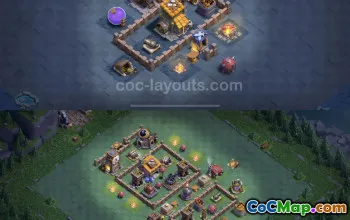
Your base’s job is not to be unbreakable; it is to be unpredictable and expensive to crack. Good defense keeps you in a trophy band where your offensive plan still farms reliably.
Two-Stage Layout Principles
- Stage One should invite the wrong answer. Present a tempting angle that burns time and key troops but does not unlock Stage Two easily.
- Stage Two should punish overcommitment. Protect core defenses (Roaster, Crushers, Mega Tesla) with overlapping coverage.
- Trap intent matters more than symmetry. Ask: which troop beats my layout? Then set traps for that army.
Anti-Meta Trap Blueprints
- Anti-Sneaky Archer
- Staggered double cannons behind line-of-sight blockers to force cloak reveal
- Spring traps just inside the first compartment corners where archers path
- Anti-Cannon Cart spine
- Push traps and Crushers at the first turn of the main lane to break tank-Cart spacing
- Multi Mortar positioned to hit where Carts clump after the first bend
- Anti-Night Witch and Minion swarms
- Roaster with guard in Stage Two; air bombs away from easy snipe angles
- Tesla farm off-center to zap bats and force path reevaluations
Compartment Design for Two-Stage Play
- Stage One compartments should look snipeable but conceal splash crossfire.
- Short walls and offset gates force Bomber exposes; many players waste Bombers before tanks anchor.
- Preserve a late Crusher in Stage Two where your expected Giant path converges.
Defensive Upgrade Priorities by BH Tier
- BH6–BH7
- Crushers to competitive levels first; a level behind can flip a 55 percent into a hold
- Air Bombs early if your bracket is swarming with Baby Dragons
- BH8–BH9
- Roaster and Multi Mortar upgrades to deny Night Witch and Archer spam
- Traps: springs and pushers; these convert near-wins into timeouts
- BH10
- Mega Tesla and key splash at the top, then targeted trap tuning based on replays
- Do not neglect point damage; a few under-leveled cannons can leak Baby Dragon funnels
Trophy Management: Find and Hold Your Sweet Spot
Optimizing loot often means settling into a trophy band where your offense hits cleanly and your defense trades evenly. Here is how to find it:
-
Establish a baseline
- Play 15–20 attacks over two sessions without changing your army or base
- Record wins, average percent, and time per attack
-
Adjust one variable at a time
- If your win rate is under 55 percent, rotate in safer openers (more Archers, fewer Carts)
- If your win rate is above 75 percent, consider pushing to a higher band for better per-win value
-
Use intentional drifting
- After upgrades, push 100–200 trophies to test your new ceiling
- If LPM drops across two sessions, drift back by experimenting with riskier offense to shed a little trophy weight
-
Seasonal awareness
- Early season often has looser matchups; late season compresses around strong bases
- Adjust goals: push earlier, consolidate later
Upgrade Synchronization: Keep the Flywheel Spinning
Splitting your resources between offense and defense does not mean 50–50 at all times. It means timing your spend so your win rate and hold rate never collapse together.
Offense First Windows
- When you unlock a new BH level and your camp or hero power spikes are near
- When your current trophy band is defense-light and you can snowball wins
Priorities:
- Star Laboratory: max your main win condition troops first
- Camps and Army capacity: an extra unit slot can be more valuable than a minor defense level
- Hero upgrades: plan them when you can tolerate a short-term dip; stop at key breakpoints that dramatically change fights
Defense Catch-Up Windows
- When your replay feed shows consistent 60–70 percent losses
- When you keep matching above your comfort band due to easy offense wins
Priorities:
- Splash and pivotal counters first (Crushers, Roaster, Multi Mortar, Mega Tesla)
- Traps tuned around the most common army you face in your bracket
- Point defenses and walls as finishers to tighten time
Balanced Queue Planning
- Pair a long defense upgrade with a shorter lab upgrade so you do not stall both sides
- Use Clock Tower boosts to finish queued small upgrades and squeeze extra attacks while boosts are active
- Keep builders staggered so you can react to meta shifts rather than being locked into multi-day queues
Example Session Plans for Higher Loot Per Minute
BH7 Mixed Bracket Plan
- Army: 10 Sneaky Archers, 2 Bombers, 8 Giants, 6 Cannon Carts, Battle Machine
- Plan: Stage One chip outer anti-cart structures, open one wall; Stage Two main push
- Defense: Crusher and Air Bombs prioritized; spring traps at first turn after entry
- Trophy band goal: 1900–2100, aiming for 65–70 percent win rate
Loop:
- Attack cadence: 2 minutes 30 seconds per battle average
- If you record three straight 40–50 percent losses, switch opener to heavier Archers before pushing again
BH9 Anti-Air Bracket Plan
- Army: Baby Dragons spam controlled with machine tanking; pocket of Archers for cleanup
- Plan: Stage One strip Air Bombs or Roaster; Stage Two sweep with air
- Defense: Roaster maxed, Tesla farm off-center to disrupt bat or minion lines
- Trophy band goal: 2700–2900
Loop:
- Track how many air traps you trigger in Stage One; commit to air only if at least two are sprung
- If defense logs multiple 70 percent losses from ground, retune push traps to disrupt Cart lines
BH10 Control Plan
- Army: Surgical Stage One with 6–10 Archers and 1–2 Bombers; Stage Two Giants and Carts plus Machine
- Plan: Remove a crusher and a key splash, preserve hero and carts for Stage Two
- Defense: Mega Tesla first, then Multi Mortar, targeted traps against Cart spines
- Trophy band goal: 3300–3600 for consistent LPM
Loop:
- Review replays for where your opponent’s Carts die; relocate push traps to that choke
- Micro-adjust Bomber timing to ensure wall opens after your Giants have full aggro
Reading Replays: The Fastest Way to Improve Balance
Replays are your blueprint for change. Ask three questions after each session:
- What troop or defense decided the attack?
- If your Carts died instantly, you need better funnel, stagger, or you must remove a specific splash defense first.
- Where did the plan fail by 10 percent or 10 seconds?
- Time losses suggest pathing or cleanup issues; structural losses suggest tanking or DPS problems.
- Which traps overperformed or never triggered?
- Move idle traps toward the common approach. A single well-placed spring can erase two Giants and swing a push.
Make one change at a time, then reassess in 5–10 battles. Balance is iterative.
Common Pitfalls That Kill Loot Flow
- Overcommitting Stage One
- Burning your Machine and main DPS for a flashy opener often leaves nothing to close.
- Ignoring trap tuning
- Static traps become solved by your bracket; refresh locations weekly.
- Upgrading only offense or only defense for days
- Double-dipping low win rate and low hold rate traps you in a weak bracket.
- Chasing trophies without a win plan
- You can climb, but if LPM falls, your progression stalls.
Actionable Checklist Before You Queue
- Offense: Do I have a clean Stage One task and a Stage Two win condition?
- Hero: Is my hero supporting my chosen troop synergy and is its path predictable?
- Defense: Have I moved at least one trap since the last session to break patterns?
- Trophy band: Am I in my target range for 60–75 percent wins?
- Upgrades: One offense, one defense, staggered—both contributing to the current plan
Conclusion: Sustainable Loot Comes From Symmetry
In Builder Base, you do not farm loot by picking only the strongest army or by building an impenetrable maze. You farm by balancing. Set a realistic trophy band, sculpt a two-stage offensive plan with clear roles, and tune your base to punish the most common counters you face. Upgrade in sync, review replays, and make one intelligent change at a time. When offense and defense move in step, your wins feel easier, your losses teach faster, and your storages fill steadily.
Start your next session with a plan: pick your band, define your Stage One task, and adjust one trap. Your loot flywheel begins the moment offense and defense stop fighting each other and start working together.